
Client: Great Western Hospitals NHS Foundation Trust
Great Western Hospitals NHS Foundation Trust serves a population of over 300,000 across Swindon and North East Wiltshire. When the Covid-19 pandemic struck, the Trust faced a critical challenge: how to continue delivering high-quality bedside clinical teaching to medical students while minimising exposure risk to patients, students, and clinicians.
Dr Chris Jacobs and Dr Chris Turner approached Microsoft with their vision of using HoloLens 2 mixed reality headsets to transform clinical education. Microsoft referred the Trust to Veriland, recognising the need for a specialist partner who could extend Dynamics 365 Remote Assist beyond its out-of-the-box capabilities into a full clinical teaching and collaboration platform.
Veriland developed VeriLens Immersive Info — a bespoke IP layer built on top of Dynamics 365 Remote Assist that integrates with hospital clinical systems, shares real-time patient data through Microsoft Teams calls, and captures all interactions in Dynamics 365 Customer Services for governance and audit. The result was a platform that didn't just enable remote observation, but genuinely replicated the richness of in-person clinical teaching.
The pandemic created an unprecedented set of constraints for clinical education. The challenges were both immediate and structural, requiring a solution that would outlast the pandemic itself.
Veriland delivered a mixed reality clinical collaboration platform that extended Microsoft's HoloLens 2 and Dynamics 365 Remote Assist into a purpose-built healthcare teaching and consultation tool. The solution comprised three tightly integrated layers.
At the core of the solution is VeriLens Immersive Info, Veriland's proprietary IP built on Dynamics 365 Remote Assist. VeriLens extends the standard Remote Assist capabilities to communicate with a wide variety of clinical and hospital systems, pulling live patient data — X-rays, blood results, observations, medication records — and presenting it as holographic overlays within the clinician's HoloLens field of view. This means a consultant at a patient's bedside can see the patient's latest blood results floating beside them, while simultaneously sharing that view with students and colleagues joining remotely via Microsoft Teams.
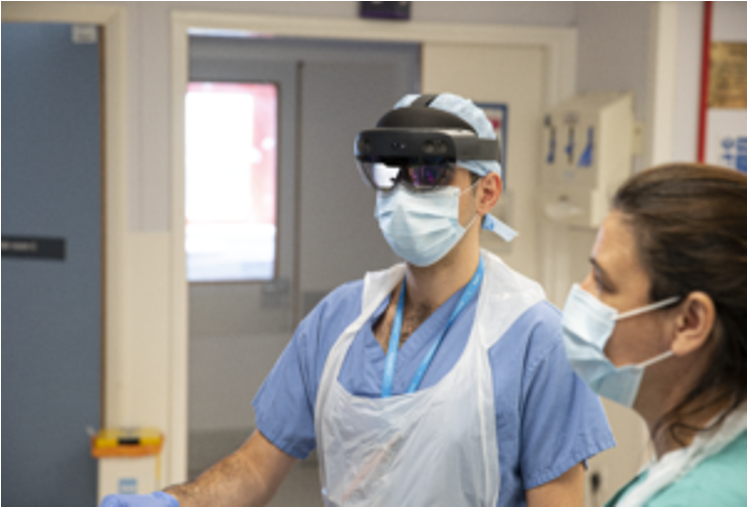
A clinician at Great Western Hospitals wearing HoloLens 2 during a bedside teaching session, with VeriLens Immersive Info providing real-time clinical data overlays.
All clinical teaching sessions and remote consultations are conducted through Microsoft Teams calls, which the HoloLens 2 headset joins natively. Remote participants — medical students, specialist consultants at other sites, multi-disciplinary team members — see exactly what the HoloLens wearer sees: the patient environment, holographic data overlays, and annotations. The platform supports bi-directional communication, so remote specialists can draw annotations that appear in the HoloLens wearer's view, guiding procedures or highlighting areas of interest during examinations.
Veriland integrated Bluetooth-enabled medical devices — digital stethoscopes and otoscopes — with the HoloLens platform. When a clinician auscultates a patient's chest using a connected Bluetooth stethoscope, the audio is streamed live to all Teams participants. Similarly, otoscope imagery is captured and shared in real time. This transforms remote observation from passive video watching into genuine clinical participation, where students can hear heart and lung sounds and see examination findings as if they were standing beside the clinician.
Every interaction, consultation, and teaching session conducted through the platform is automatically captured and stored in Dynamics 365 Customer Services. This includes session metadata (participants, duration, patient context), any annotations or notes made during the call, and a complete audit trail of which clinical data was accessed and shared. This satisfies NHS information governance requirements and provides the Trust with a structured record of clinical teaching activity for accreditation and quality assurance purposes.
The platform enabled Great Western Hospitals to not only maintain clinical education during the pandemic, but to pioneer a new model of mixed reality healthcare delivery with applications well beyond teaching.
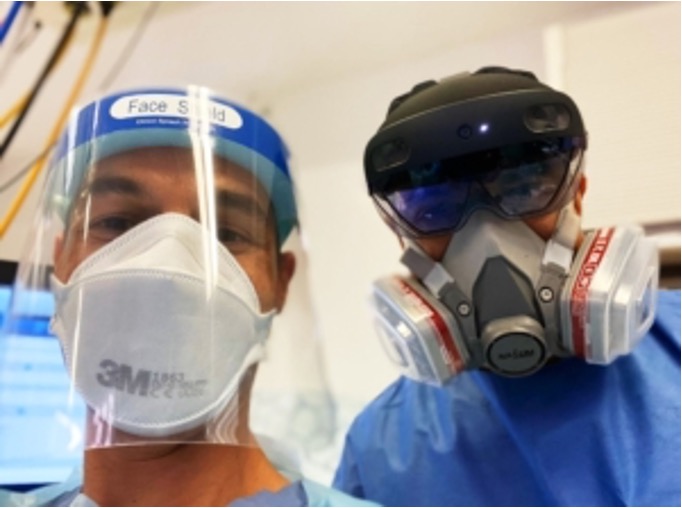
Clinicians in full PPE using HoloLens 2 during a Covid-19 patient consultation, enabling remote multi-disciplinary collaboration through VeriLens and Microsoft Teams.
"We are hoping that we could use the HoloLens to deliver bedside and clinic-based teaching to medical students and a range of other types of teaching such as Teaching Grand Rounds, simulation training and observation of operations and procedures. We were also hoping to link up a Bluetooth stethoscope so students could hear a chest being auscultated and an otoscope for ear and throat examination."
The platform's architecture was designed for the specific demands of NHS clinical environments — where data governance, device reliability, and seamless integration with existing hospital infrastructure are non-negotiable.
The Microsoft HoloLens 2 headset runs Dynamics 365 Remote Assist as its base application, providing hands-free mixed reality with spatial anchoring, gesture and voice control, and native Teams calling. Veriland extended this with the VeriLens Immersive Info agent — a custom application layer running on the HoloLens that manages clinical system connections, data retrieval, and holographic rendering of patient information. The headset connects to the Trust's Wi-Fi infrastructure with enterprise certificate-based authentication, ensuring all data traverses the hospital's secured network.
VeriLens communicates with the Trust's clinical systems through secure APIs and HL7 FHIR interfaces. When a clinician identifies a patient context, VeriLens retrieves relevant clinical data — pathology results, radiology images, observation charts, medication records — and renders them as holographic panels positioned in the clinician's field of view. The integration layer handles data transformation between clinical system formats and the mixed reality rendering pipeline, with all data requests logged for information governance audit.
Bluetooth-enabled medical devices (digital stethoscopes, otoscopes) connect to the HoloLens via a custom Bluetooth bridge service. Audio streams from stethoscopes are captured, processed for noise reduction in the clinical environment, and routed into the active Teams call as a dedicated audio channel — so remote participants hear the clinical audio clearly alongside the clinician's voice. Otoscope video feeds are captured and composited into the HoloLens's shared visual stream, appearing as an inset panel for remote viewers.
All real-time collaboration flows through Microsoft Teams, leveraging Azure Communication Services for low-latency audio, video, and data channel management. The HoloLens joins Teams meetings as a first-class participant, sharing its mixed reality view — including holographic overlays and annotations — with all remote attendees. Remote participants can annotate directly in the shared view, with their markings rendered spatially in the HoloLens wearer's environment.
Every session is recorded as a structured case in Dynamics 365 Customer Services. The integration captures session start/end times, participant lists, patient context identifiers (where applicable), clinical data accessed during the session, annotations made, and session type classification (teaching, consultation, multi-disciplinary team review). This data feeds into the Trust's information governance reporting and provides a searchable archive of clinical teaching activity for medical education accreditation.
The entire platform operates within the Trust's NHS network boundary. All data in transit is encrypted via TLS 1.3, and data at rest in Dynamics 365 is encrypted with Microsoft-managed keys within the UK Azure regions. Access is controlled through NHS Identity via Azure Entra ID, with role-based permissions ensuring that clinical data is only accessible to authorised clinicians. The platform was assessed against the NHS Data Security and Protection Toolkit (DSPT) requirements prior to deployment.

Microsoft HoloLens 2
Mixed reality headset providing hands-free holographic computing with spatial awareness, gesture control, and voice commands for clinical environments.

Dynamics 365 Remote Assist
Foundation for remote collaboration with spatial annotations, asset capture, and native Microsoft Teams integration — extended by Veriland's VeriLens IP.
VeriLens Immersive Info
Veriland's proprietary IP layer that integrates clinical systems with the mixed reality environment, rendering live patient data as holographic overlays.

Dynamics 365 Customer Services
Session governance and audit platform capturing all clinical teaching and consultation interactions with full data lineage for NHS compliance.

Azure Communication Services
Low-latency audio, video, and data channel management powering the real-time sharing of mixed reality views and medical device feeds.

HL7 FHIR Integration
Secure clinical data interoperability layer connecting VeriLens to the Trust's pathology, radiology, and electronic patient record systems.

Azure Entra ID & NHS Identity
Identity and access management with role-based clinical permissions, aligned to NHS Data Security and Protection Toolkit requirements.